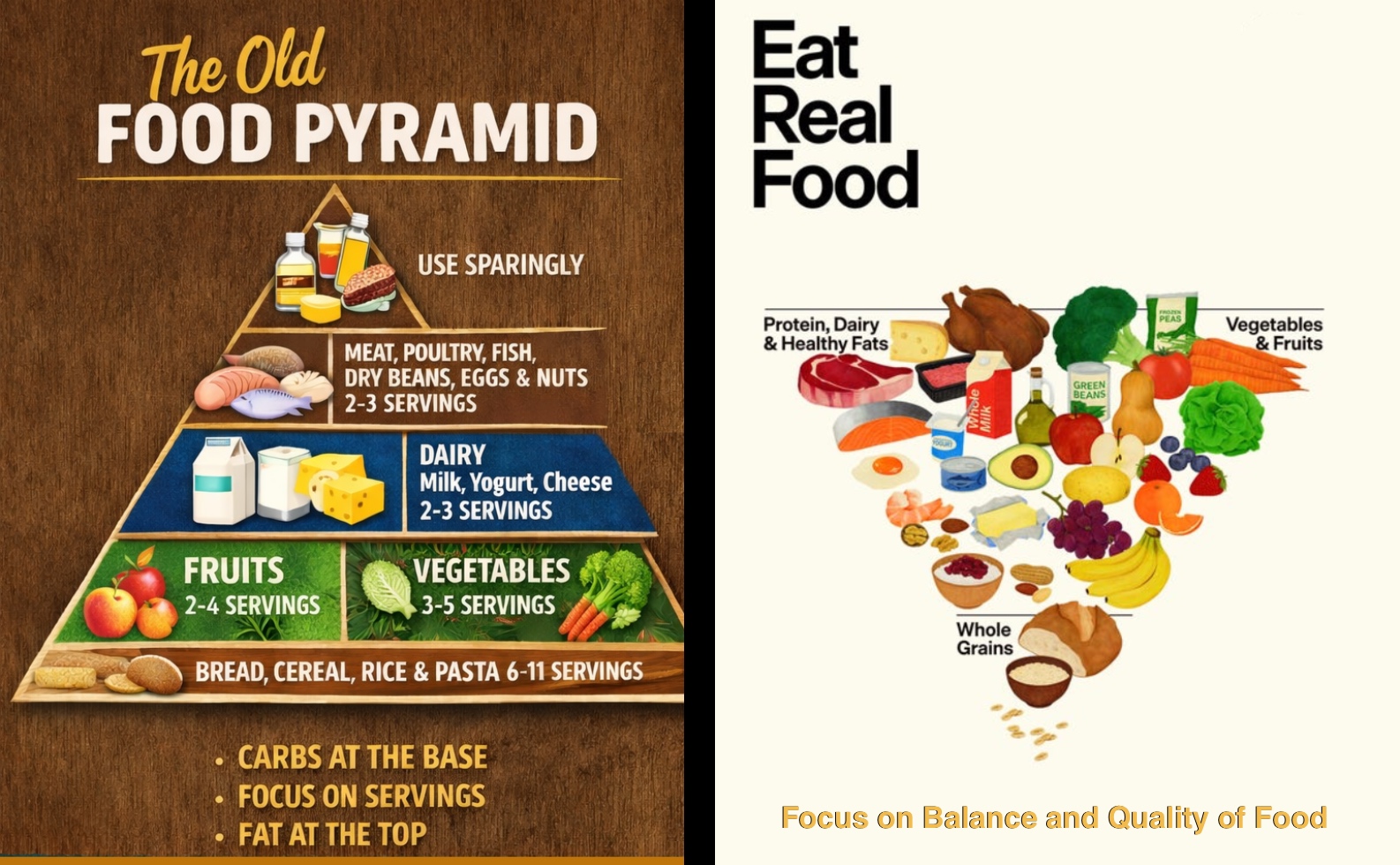
 For decades, we were told that health was a simple math equation: eat less, move more, avoid fat, and build meals around grains. We trusted the food pyramid because we were told it was based on science, designed for our well-being, and meant to protect us from disease.
Yet here we are.
Despite following those guidelines, rates of obesity, type 2 diabetes, fatty liver disease, autoimmune disorders, hormonal imbalance, heart disease, and certain cancers have continued to rise.
We are overfed and undernourished at the same time.
Recently, something remarkable happened.
The nutritional narrative shifted.
The food pyramid was essentially turned upside down—not because people failed, but because the model itself was flawed.
The Old Food Pyramid: A Carb-Based Experiment
For over 40 years, the foundation of the old food pyramid was carbohydrates.
- 6–11 servings of grains per day
- Low fat
- Low cholesterol
- Low saturated fat
- Calories in versus calories out
The assumption was that fat made us sick and carbohydrates were harmless fuel.
What was often left out of the conversation was a basic biochemical truth:
Carbohydrates—especially refined ones—convert to sugar in the body.
When carbohydrates dominate the diet, blood sugar rises. When blood sugar rises repeatedly throughout the day, insulin must work harder and harder to keep up.
Over time, this leads to insulin resistance, the root cause of many chronic illnesses.
This model encouraged constant eating, frequent snacking, and a fear of satisfying foods. Hunger became something to suppress instead of a signal to interpret.
The New Understanding: Ultra-Processed Foods and Chronic Disease
Modern research is now pointing clearly to what drives the majority of chronic disease today:
Ultra-Processed Foods (UPFs)
These foods are not simply “convenient.” They are industrial formulations designed for shelf life, hyper-palatability, and profit—not nourishment.
Current data suggests that UPFs are a primary driver behind nearly 90% of chronic disease, including:
- Obesity
- Type 2 diabetes
- Fatty liver disease
- Cardiovascular disease
- Certain cancers
- Neuroinflammation and cognitive decline
In today’s world, over 50% of total caloric intake comes from ultra-processed foods. Many people are not eating too much food—they are eating too much non-food.
What the New Food Model Prioritizes
The updated nutritional framework shifts away from restriction and moves toward nourishment.
Instead of asking, “How little can I eat?” the new question becomes:
“How well can I feed and nourish my body?”
This new model emphasizes:
- Real, whole foods
- Minimizing or eliminating ultra-processed foods
- Blood sugar stability
- Adequate protein
- Healthy, traditional fats
- Hormonal and metabolic health
This is not a trend. It is a return to biological design.
Protein: The Missing Foundation
One of the most significant shifts in nutritional science has been the reassessment of protein needs.
Old recommendation: 0.8 grams of protein per kilogram of body weight
A 180-pound individual required approximately 65 grams of protein per day.
New evidence-based recommendation: 1.2–1.6 grams of protein per kilogram of body weight
That same individual now requires 98–131 grams of protein per day.
Protein is essential for:
- Tissue repair and regeneration
- Muscle preservation as we age
- Hormone production
- Immune function
- Blood sugar regulation
- Satiety and appetite control
Many people today are protein deficient, not calorie deficient. Quality matters, and highly bioavailable protein sources—such as eggs, fish, poultry, dairy (if tolerated), and responsibly sourced red meat—play a critical role in metabolic health.
Saturated Fat: Restoring a Misunderstood Nutrient
Saturated fat was once labeled as dangerous, yet it plays a vital role in the body.
We need saturated fat for:
- Brain and neurological health
- Hormone synthesis
- Cell membrane integrity
- Nutrient absorption
When saturated fat was removed from the diet, it was often replaced with industrial seed oils and processed low-fat products. These replacements increased inflammation rather than reducing disease.
Fat was never the enemy.
Processing was.
Industrial Starches: The Hidden Saboteurs
One of the most damaging aspects of the modern food supply is the widespread use of industrial starches and refined carbohydrates.
Ingredients to watch for include:
- Modified corn starch
- Modified food starch
- Refined flour products
- Maltodextrin (a hidden sugar that raises blood glucose more than table sugar)
These ingredients disrupt blood sugar, increase insulin demand, and provide no meaningful nourishment to the body.
Insulin Resistance: The Root of Modern Disease
At the heart of most chronic illness is insulin resistance.
This condition is driven by:
- Continuous eating
- High refined carbohydrate intake
- Ultra-processed foods
- Chronic stress
- Poor sleep
When insulin resistance develops, the body struggles to regulate energy, store fat appropriately, and maintain hormonal balance.
Intermittent Fasting: A Tool for Restoration
Intermittent fasting is not about deprivation—it is about giving the body time to rest.
Benefits may include:
- Improved insulin sensitivity
- Reduced inflammation
- Cellular repair
- Improved metabolic flexibility
Even gentle forms of intermittent fasting—such as reducing constant snacking or allowing clear time between meals—can support healing.
What Is Real Food?
Real food has one purpose: to support life.
Real food:
- Promotes growth and repair
- Nourishes cells
- Supports hormonal signaling
- Sustains long-term health
If food comes from the earth or an animal, is minimally altered, and is recognizable without a label, it is likely real food.
A Return to Wisdom
The food pyramid did not fail because people lacked willpower.
It failed because it ignored how the human body actually works.
The shift toward real food is not radical—it is restorative. It invites us to eat with gratitude, intention, and trust in the wisdom built into creation.
When we nourish the body properly, it remembers how to heal.
Closing Prayer
Heavenly Father,
We thank You for the gift of our bodies—fearfully and wonderfully made, designed with wisdom and care.
Grant us clarity in a world filled with confusion and discernment in the choices we make each day. Help us return to what is simple, nourishing, and life-giving.
Bless the food that sustains us. Heal what has been inflamed, restore balance where it has been lost, and guide us toward habits that support health, strength, and peace.
May our choices honor You, our health serve Your purpose, and our lives reflect gratitude for the abundance You provide.
In the name of the Father, of the Son and of the Holy Spirit,
Amen.