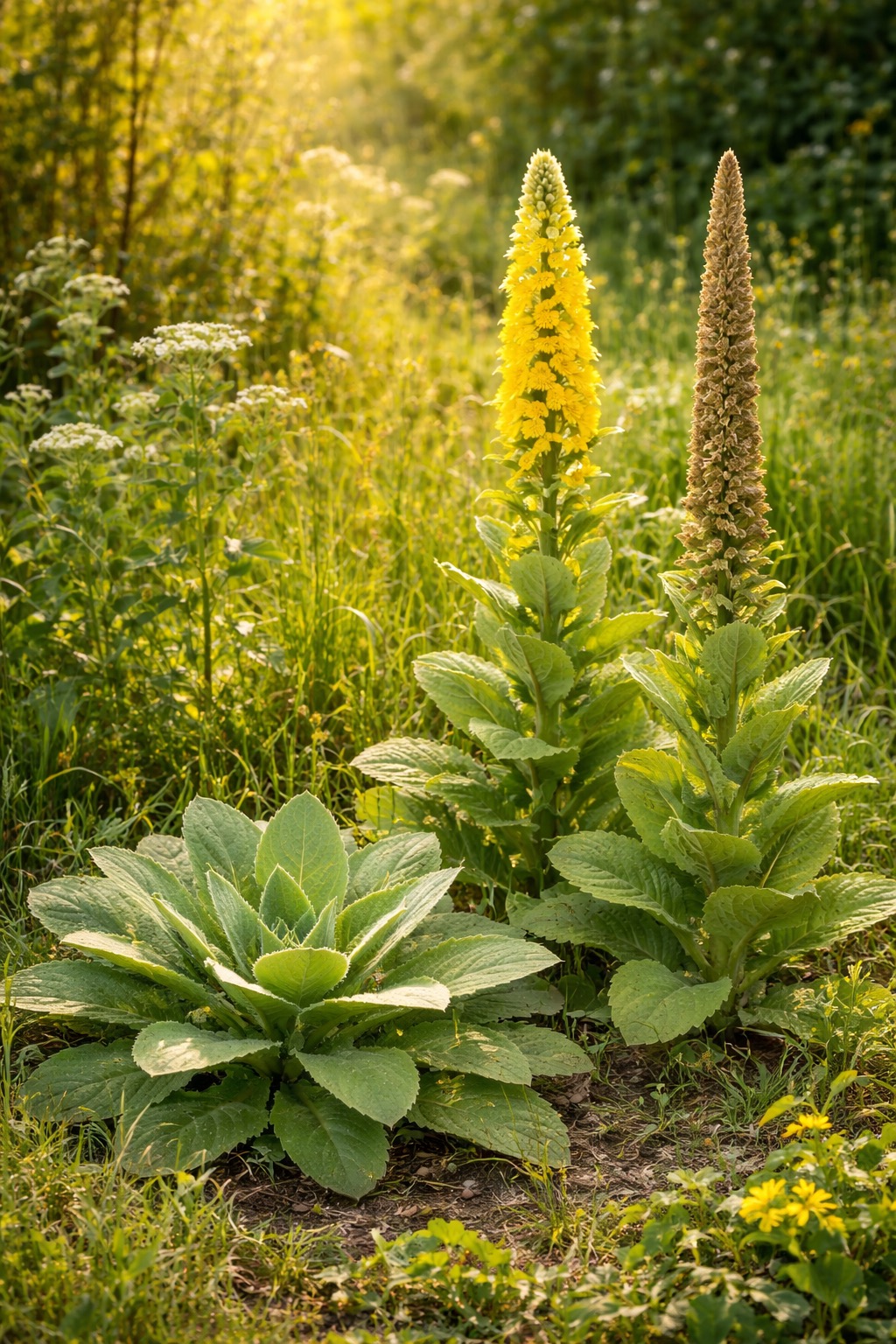
 Mullein: The Quiet Sentinel of Healing Fields
Mullein and I have had a very intimate relationship with one another as this particular gift of the earth has helped my lungs become stronger. It’s one of the most important medicines we have in our personal home apothecary.
There are plants that demand attention—fragrant, cultivated, praised.
And then there are those that rise quietly along forgotten paths, in gravel, in fields long neglected…
uninvited, unnoticed, and often unwanted.
Mullein is one of these.
Known botanically as Verbascum Thapsus, it arrives quietly, without recognition. It does not require rich soil or careful tending. It appears where the land has been worn down, compacted, or overlooked—as if answering a call no one else heard.
And yet, within its soft, silvery leaves and tall golden spire, it carries a kind of wisdom that speaks to both earth and body.
A Plant That Rises Where Healing Is Needed
In its first year, mullein stays low to the ground—a rosette of thick, velvety leaves, soft as wool, hugging the earth as if listening closely to it.
In its second year, it transforms.
A single stalk rises—sometimes six, even eight feet tall—lined with small yellow flowers that open gradually, one after another, like a slow-burning candle.
It does not rush.
It does not compete.
It simply becomes.
And often, it becomes in places where very little else will.
The Breath of the Land, the Breath of the Body
For generations, mullein has been known as a plant of the lungs.
Not in a loud or forceful way—but in a gentle, steady presence. It soothes. It opens. It supports.
A warm infusion of its leaves, carefully strained, has long been used to calm coughs, ease irritation, and help the body release what it no longer needs. Where breath feels tight, mullein offers space.
Where there is dryness or inflammation, it brings softness.
Its action is not aggressive. It does not override the body.
It works with it—encouraging movement, easing tension, restoring rhythm.
Even its flowers carry their own quiet medicine. Infused into oil, they have been used for generations to comfort the ear, bringing relief in moments of discomfort.
There is a theme here, if you look closely:
Mullein tends to places that are congested, inflamed, or constricted—
whether in the lungs, the tissues, or the land itself.
The Healer Beneath the Surface
What mullein does above ground is only part of the story.
Below the soil, its long taproot moves deep into hardened earth—breaking through compacted layers, drawing minerals upward, creating pathways where none existed before.
Where the ground has been pressed down, depleted, or stripped of life, mullein begins the slow work of restoration.
It does not demand fertile soil.
It creates the conditions for it.
And when its life cycle is complete, it gives itself back—its roots decomposing, its structure returning to the earth, leaving behind a soil that is softer, richer, more alive than before.
It is, in every sense, a pioneer—a first responder to imbalance.
A Gift to More Than Just Us
As its flowers open, one by one, they become a source of nourishment for bees and other pollinators—especially in the heat of summer when resources can grow scarce.
Its tall stalk offers rest to birds.
Its seeds provide food through colder months.
Its presence invites life back into places where life had thinned.
It does not take from the ecosystem.
It participates in it—fully, generously.
A Companion Through Time
Mullein’s relationship with humanity stretches back thousands of years.
Ancient physicians recorded its use for lung conditions and wound care. Dioscorides (c. 40–90 AD), a Greek physician in the Roman army, documented the use of Mullein (Verbascum Thapsus) in his foundational 1st-century treatise, De Materia Medica. He recommended the herb for pulmonary diseases, specifically identifying it as a remedy for coughs, bronchitis, and other respiratory issues.
In medieval times, its dried stalks were dipped in wax or fat and used as torches—earning it names like “candlewick plant.”
It traveled across continents, eventually taking root in North America, where it grew freely along roadsides and open land. Though not native, it was recognized and adopted by those who observed its nature and its usefulness.
It became, once again, what it had always been:
A plant that shows up when needed.
Ways to Work With Mullein
To bring mullein into daily life is to engage with it simply.
A tea made from its dried leaves—soft, earthy, grounding—can be sipped slowly, especially when the lungs or throat feel strained. Care is taken to strain it well, as the tiny hairs that give the plant its softness can be irritating if left in the liquid.
Its flowers, golden and delicate, can be infused into oil over time, capturing their gentle properties. This oil has been used traditionally to comfort the ears and soothe the skin.
In moments of congestion, the steam of mullein rising from hot water can be inhaled carefully, offering warmth and ease to the breath.
Even as a poultice, its leaves have been placed against the body to soften and calm areas of tension or irritation.
There is nothing complicated here.
No elaborate preparation required.
Just patience, presence, and respect.
How It Grows (and What That Teaches Us)
If there were ever a plant that embodied both resilience and service, it’s mullein—soft-leaved in its first year, towering like a candle in its second, offering medicine, habitat, and restoration wherever it grows.
Mullein does not ask for much.
Give it sunlight.
Give it space.
Leave the soil as it is.
Its seeds do not need to be buried deeply. They rest on the surface, waiting for the right conditions. And when those conditions arrive, they begin.
It thrives where other plants hesitate.
Which makes it both easy to grow—and easy to misunderstand.
Because in a world that values control, uniformity, and predictability, a plant that chooses its own place, grows on its own terms, and spreads freely can be seen as a problem.
But perhaps the question is not why it grows so easily…
Perhaps the question is why we have forgotten how to see its value.
Mullein does not force its way into importance.
Mullein does not compete for attention—it rises where the land is hurting, softens what is hardened, and offers healing to both earth and breath.
It simply appears—
where the land is hardened,
where the air is heavy,
where something has been pushed out of balance.
And it begins its work.
Softening.
Opening.
Restoring.
There is something deeply humbling in that.
Because the same places we often try to clear, control, or remove…
are often the very places where healing is quietly trying to begin.
And sometimes, the most overlooked plant in the field
is the one doing the most necessary work.
What Mullein Does for the Body
Lung & respiratory support (its most well-known gift)
Mullein has long been used for:
- coughs (dry or productive)
- bronchitis
- asthma support
- irritation from smoke or pollution
How it works:
- Acts as an expectorant (helps move mucus out)
- Contains soothing compounds that coat irritated tissues
Anti-inflammatory & soothing
Used for:
- sore throat
- inflamed tissues
- digestive irritation
Antimicrobial properties
Traditionally used to help the body respond to:
- mild infections
- respiratory pathogens
Ear health (a classic folk remedy)
Mullein flower oil has been used for:
- earaches
- mild ear irritation
(often combined with garlic in traditional preparations)
Nervous system calming
Mullein tea is gently:
- relaxing
- grounding
- supportive during illness recovery
How to Use Mullein (Practical + Traditional)
Tea (most common)
Parts used: dried leaves or flowers
Benefits:
- lungs
- throat
- immune support
Important tip:
Always strain through fine cloth or filter—tiny hairs on the leaves can irritate the throat.
Mullein Flower Oil
Used for:
- ear drops
- skin soothing
How:
- infuse fresh or dried flowers in olive oil for 2–4 weeks
- strain well
Herbal steam (beautiful for content creation too)
- Add leaves to hot water
- Inhale steam (carefully)
Supports:
- sinus congestion
- lung clearing
Smoke (traditional use—not for everyone)
Historically, dried mullein leaves were smoked for:
- asthma
- lung congestion
This is part of traditional practice, but not commonly recommended today due to modern understanding of lung health.
Poultice
Crushed fresh leaves applied to:
- wounds
- inflammation
- joint discomfort
Syrup
Mullein tea + honey reduced into a syrup:
- soothing for coughs
- helpful for children (when age-appropriate)
What Mullein Does for the Land
shows up when land is:
- compacted
- depleted
- disturbed
Its role:
- deep taproot breaks up hard soil
- pulls nutrients from deep layers
- improves soil structure over time
Prepares land for future growth
After mullein completes its life cycle:
- roots decompose
- organic matter increases
- soil becomes more hospitable for other plants
It’s like a first responder for damaged ground.
Even the leaves of mullein are not its own—it offers them freely, sustaining the small, unseen lives that in turn sustain everything else.
Benefits to Insects, Birds & Wildlife Pollinators
- Bees love the bright yellow flowers
- Provides nectar during mid to late season
Insects
- Host plant for certain moths and beneficial insects
Birds
- Seeds feed birds in fall and winter
Habitat
- Tall stalks provide shelter and perching
How to Grow Mullein. Conditions it loves:
- Full sun
- Poor to average soil
- Dry conditions
(It actually thrives where other plants struggle.)
Growth cycle
- Year 1: soft rosette of fuzzy leaves
- Year 2: tall flowering stalk (can reach 6–8 feet)
Planting tips:
- Scatter seeds on soil surface (needs light to germinate)
- Do not bury deeply
- Minimal watering once established
Note:
- Self-seeds easily
- Consider placement if you don’t want it spreading freely
The next time you step outside, take a good look around and see if you can find mullein. As you take a closer look remember that mullein is often labeled a “weed” because:
- it grows where it’s not invited
- it thrives without permission
But when you look closer, it:
- heals lungs
- restores soil
- feeds insects
- shelters life
It doesn’t take.
It gives—quietly, consistently, without recognition.
A true GIFT given freely for all. One that should be well known across the lands.