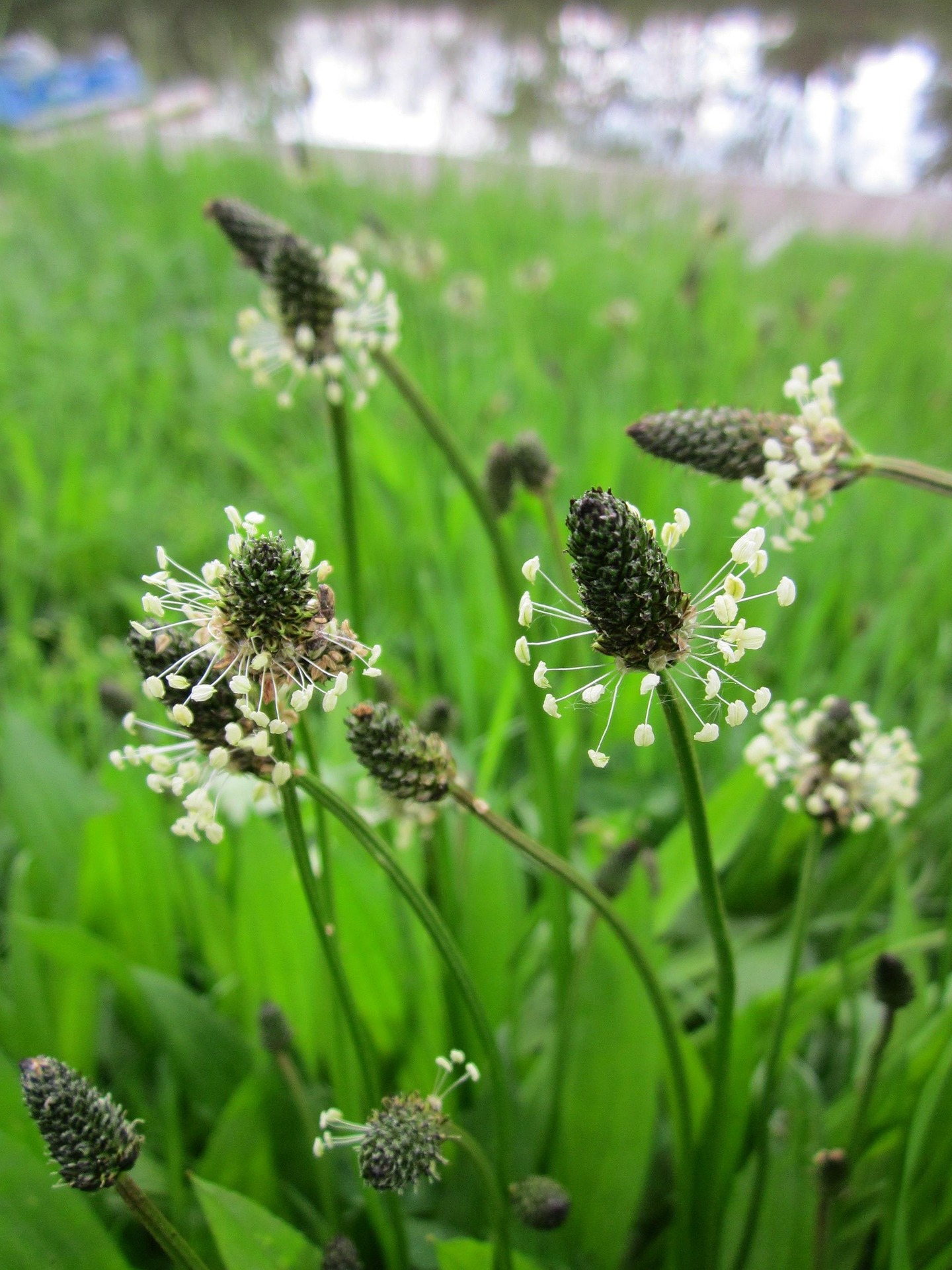
Plantago major / Plantago lanceolata
Plantaginaceae family
Other Name
- Common Plantain
- Broadleaf Plantain
- Narrow leaf Plantain
Similar Plants
- Rugel’s Plantain
Plantago, known as *Plantain*, is a remarkable herb celebrated for its numerous health benefits, particularly in muscle relaxation and respiratory wellness. This versatile plant is not only easy to find but also offers a holistic approach to various ailments.
Plantago is considered a common weed. However, it has been used for thousands of years as a medicinal plant (for inflammation, bleeding, and infections) as well as a potherb and salad green. It is also a great addition to the garden, as it attracts beneficial insects, is a dynamic mineral accumulator, is tolerant of drought and is a great forage crop for animals.
This leafy plant aids many different systems in the body including the respiratory tract (upper respiratory infections, asthma, bronchitis, cough), gastrointestinal tract (ulcers, diarrhea), and urinary tract (urinary tract infections).
One of the incredible properties of plantago is its ability to help relax muscles and alleviate cramps and spasms. Whether you’re dealing with muscle tension from exercise or everyday stress, incorporating plantain can provide soothing relief. It also has natural anti-inflammatory effects, making it beneficial for reducing discomfort and promoting relaxation in strained muscles.
Plantago is widely acknowledged for its supportive role in respiratory health. It possesses calming and purifying properties, which aid in clearing mucus from the airways. This makes breathing easier and more comfortable, especially for those affected by congestion or respiratory issues. Additionally, plantain strengthens the mucous membranes, which are vital for protecting our respiratory and digestive systems, ensuring they function optimally in the most natural way as God intended.
When applied topically, plantago excels in promoting wound healing. It enhances the skin’s recovery process, effectively stopping bleeding and accelerating the healing of cuts and abrasions. Its natural antiseptic qualities also support skin health, making it a valuable addition to herbal remedies for skin care.
Plantago provides significant digestive benefits. It is known to alleviate symptoms associated with digestive disorders like irritable bowel syndrome (IBS), gastritis, hemorrhoids and ulcers. Its ability to reduce intestinal inflammation leads to improved comfort and overall digestive health.
In summary, plantago is a powerhouse herb that can enhance muscle relaxation, support respiratory health, facilitate healing, and promote digestive comfort. With its myriad of benefits, this simple plant can be an essential part of your health and wellness routine.
Plantago is a perennial plant that grows in many locations from spring to autumn. Not only is this a vital wild edible plant for overall good health, this wild weed can be used to treat chronic diarrhea as well as digestive tract disorders. Plantago is packed with nutrients and is safe to ingest. If a person chews on some fresh leaves, these can be applied to the skin to treat minor burns, insect bites or open wounds.
I used plantago personally when a freak accident occurred and I found myself with a piece of metal shard in my upper chest. I immediately rushed into the nearby woods, harvested plantago leaves while deep breathing through the pain and began masticating the leaves well to put on the spot. Not long after it helped bring the metal shard to the surface and out of my body. Everyone around me was amazed. Before this, many thought I was a wee bit on the strange side. I love when nature proves its value this way.
The same plant that soothes also strengthens—depending on which part you call upon.
The native Indians called the P. major the “white man’s foot” because they notice whereever he went the plant soon showed up.
Let’s dive a little deeper, shall we?
What are Plantago’s functions
- Antiinflammatory
- Antifungal
- Antimicrobial
- Skin healer (drawing agent)
What is its ecological role?
- Soil compaction indicator
- Pioneer plant in disturbed soil
Distinguishing Features
Plantago major (Broadleaf) leans more toward:
- Cooling
- Moistening
- Drawing out (like a poultice)
Best known for:
- Bug bites, stings, splinters
- Skin irritation, rashes
- Dry coughs and inflamed tissues
- Gut lining support
This is your first-aid, comforting, “mothering” plant
Broadleaf plantain has green, oval to egg-shaped leaves that grow in a rosette. These leaves have thick stems that meet at a base, are hairless or sparsely short haired.
The leaves grow in a rosette and can range from 6-12 inches in length. When these stems are broken, they reveal string-like veins that resemble those in celery.
There are five to seven prominent parallel veins from the base.
Narrowleaf — the lung ally
Plantago lanceolata leans more toward:
- A bit more drying
- More toning/astringent
- Stronger respiratory affinity
Best known for:
- Lung support (coughs, mucus, irritation)
- Smokers or post-illness lung recovery
- Mild antimicrobial support
- Wound healing (still excellent, just slightly different feel)
This is your focused, respiratory-support, “restorative” plant
Narrow leaf plantain has long, thin, lanced shaped leaves and grows more upright with a grass like appearance. Leaves are narrower and more fibrous. Nicknamed “ribwort” for its distinctive ribbing.
In other words, Broadleaf looks like a spoon and narrowleaf looks like a blade.
Fiber is an important element of identification.
Internally (tea, syrup, tincture)
- Broadleaf: better when things are dry, inflamed, irritated
- Narrowleaf: better when there’s mucus, lung congestion, lingering cough
But truthfully?
Most herbalists will use them interchangeably in tea blends because they both have such amazing medical healing qualities ands work beautifully together.
Externally (this is where broadleaf shines)
- Broadleaf is usually preferred for:
-
- Fresh poultices (chew and apply—yes, the old ways still work)
- Drawing out infection or venom
- Soothing inflamed skin
- Narrowleaf still works—but:
-
- Slightly less juicy
- A bit more “tightening” than “drawing”
Nutritional + mineral differences (subtle but worth noting)
Both contain:
- Calcium
- Magnesium
- Silica
- Vitamins A, C, and K
But:
- Broadleaf tends to feel more nutritive and moistening
- Narrowleaf slightly more medicinal/targeted
The honest herbalist answer
If someone handed you one and not the other…
You could still do 90% of the same work with either.
The difference is refinement—not limitation.
Some plants comfort you…
some plants strengthen you…
and some—like plantain—quietly do both, just in different ways.
Flowers
Plantago flowers occur in compact spikes on erect, leafless stalks from among the basal leaves. Each spike is about the size and shape of a pencil but consisting of many, tiny, stalkless, greenish flowers giving it a coarsely granular texture. Each flower measures 1/12- 1/8 inches across. Each flower has four petals, two stamens, and one pistil. Egg-shaped seedpods develop beneath the withering flower.Flowers from spring until late autumn.
Height
Can grow to a height of about 5 inches.
Habitat
Can be found growing throughout Ontario and most of North America as well as in Europe and Asia in meadows, pastures, lawns, roadsides, gardens, and waste places.
Edible and Medicinal Parts
The entire plant is edible and medicinal.
Leaves
Young leaves are edible raw in salad or cooked as a pot herb, they are very rich in vitamin B1 and riboflavin. They are somewhat bitter and a bit tedious to prepare because it’s generally preferable (though not required) to remove the fibrous strands before use. I personally do not take this step.
Many people blanch the leaves in boiling water before using them in salads in order to make them more tender.
I personally do not take this step either. I honestly chop my salads fairly fine to get the most nutrition from them and make them easier to masticate fully.
Once blanched, plantago leaves can be frozen and used later in a sauté, stir fry, soup or stew.
Dried leaves make a healthy herbal tea. It can also be added in powder form to any meal to boost the vitamins and nutrients.
I dehydrate or freeze dry leaves for the apothecary as well as the pantry. I simply crush when dried, store in a jar, label with a date and store in a dark cabinet.
We include Plantago in our home in many ways such as:
- Fresh leaf poultice for bites, stings, wounds
- Tea for coughs and respiratory support
- salves
- Boosting nutrition in meals
- Natural food coloring
Extracts of the plant have anti bacterial activity, it is a safe and effective treatment for bleeding, it quickly stops blood flow and encourages the repair of damaged tissue.
The heated leaves are used as a wet dressing for wounds, skin inflammations, malignant ulcers, cuts, stings and swellings and said to promote healing without scars.
Poultice of hot leaves is bound onto cuts and wounds to draw out thorns, splinters and inflammation.
A distilled water made from the leaves has been widely used for a natural and healthy eye wash.
Seeds
Seeds can be eaten raw or cooked or ground as a flour addition. Considered a great fiber source, seeds contain up to 30% mucilage which swells in the gut, acting as a bulk laxative and soothing irritated membranes.
The seeds have been used in the treatment of parasitic worms. Plantago seeds (specifically Plantago ovata or Psyllium) are used in traditional medicine as a natural, non-pharmacological agent to aid in the elimination of intestinal parasites by increasing bulk and facilitating regular bowel movements.
Some find the seeds to be tedious to harvest.
Roots
Traditional & practical uses of plantago root decoction
Digestive support
The root decoction has been used for:
- Loose stools / mild diarrhea
- Gut irritation where tissues are inflamed but also “slack”
The root tightens, calms and restore tone.
This is very different from the leaf, which is more coating and soothing.
A root decoction of Plantago major or Plantago lanceolata isn’t the most commonly used preparation—but it does have some traditional and practical uses worth knowing, especially if you’re working with the whole plant.
The root contains:
- More astringent compounds (tannins)
- Different bitter and mineral components
- Less mucilage, more toning and tightening action
So when you decoct the root (long simmer), you’re extracting a different personality of the plant.
Urinary tract support
Historically used in some traditions for:
- Mild urinary irritation
- Supporting the bladder and urinary lining
Its gentle astringency may help:
- Reduce irritation
- Tone tissues in the urinary tract
Mouth, gum, and throat rinses
A cooled decoction can be used as a:
- Gargle for sore throat
- Rinse for bleeding gums or mouth irritation
Why it works:
- It is astringent which helps tighten tissues
- It is antimicrobial which supports healing
Topical wash for wounds or skin
Used externally as a wash or compress for:
- Minor wounds
- Weepy or inflamed skin
- Insect bites
The root version leans more towards being drying and tightening vs. the leaf’s soothing and slimy feel.
Traditional use in smoking recovery
Root decoction may be used alongside leaf preparations to:
- Help tone irritated tissues after long-term smoke exposure
- Support deeper tissue repair (less soothing, more strengthening)
Embrace the healing properties of Plantago and enjoy a natural pathway to better health as God intended.
Thank you all for being here, my friends. Thank you for caring about your temple and desiring a happier, healthier, stronger life for yourselves and your loved ones.
Until next time, be gentle with yourselves, live your life with the greatest intentions and choose to love abundantly. For we are ALL worth far more than rubies. You are loved.
God Bless and be well.