 Walk down any grocery aisle in America and you’ll see the words “enriched” or “fortified” proudly displayed on breads, cereals, pastas, rice, and flours. It sounds helpful. Even virtuous. But enrichment is not the same as nourishment—and many countries have decided the risks outweigh the benefits.
So how did we get here?
For decades, Americans have been taught that fortified / enriched foods are helpful — even necessary, proving essential vitamins. Bread, pasta, cereal, grains, and snacks proudly announce: “Enriched with folic acid!”
But for a large portion of the population, this well-intended practice quietly disrupts health rather than supporting it, causing serious health issues.
Why America Began Enriching Food
Fortification was designed to address severe deficiency in a very different era.
Food enrichment in the United States began in the 1930s and 1940s, during a time when:
- poverty was widespread
- malnutrition was common
- refined flour had stripped grains of natural nutrients
- deficiency diseases like pellagra and beriberi were rampant
The solution seemed logical: Remove nutrients during processing… then add a few back later.
The original goal was not deception—it was public health triage.
Enrichment focused on adding:
- folic acid
- iron
- niacin
- riboflavin
- thiamine
And in the short term, it helped reduce severe deficiency diseases.
But short-term fixes often create long-term consequences.
What Changed—and Why the Model No Longer Fits
The food landscape today is nothing like the 1940s.
Now we have:
- ultra-processed foods as dietary staples
- constant exposure to fortified products
- synthetic nutrients added in isolation
- people consuming multiple enriched items daily
Instead of preventing deficiency, enrichment has become chronic overexposure.
And biology does not respond well to that.
True nourishment cannot be engineered — it must be cultivated.
And in addition, we now know that not everyone can tolerate these synthetic nutrients, such as folic acid, without causing serious health concerns.
Why Many Countries Restrict or Ban Enrichment
Many countries outside the U.S.:
- restrict mandatory folic acid fortification
- prefer whole-food nutrition approaches
- recognize genetic variability in metabolism
- prioritize food quality over chemical correction
- understand that some people cannot – genetically – be exposed to folic acid without causing bodily harm
Their concern isn’t deficiency — it’s biological mismatch.
Several European and other nations:
- restrict synthetic nutrient fortification
- ban mandatory folic acid enrichment
- require whole-food–based nutrition strategies instead
Why?
Because synthetic nutrients do not behave the same as food-based nutrients.
Countries that restrict enrichment cite concerns over:
- nutrient imbalances
- masking deficiencies
- unknown long-term effects
- genetic variability in metabolism
- neurological and immune impacts
They choose food quality over chemical correction.
Sadly, in the USA, not only did we fail to restrict the use of folic acid… we actually MANDATED the enrichment of many foods not certified as organic or 100% whole grain. As you’ll see below, this has led to many health problems for a large percentage of us in the USA.
Synthetic Folic Acid vs. Natural Folate: A Critical Difference
This is where the issue becomes serious—especially for those with MTHFR gene variants.
What Is the MTHFR Gene?
MTHFR (methylenetetrahydrofolate reductase) is an enzyme involved in methylation — a biochemical process essential for:
- detoxification
- neurotransmitter balance
- hormone regulation
- DNA repair
- energy production
- cardiovascular health
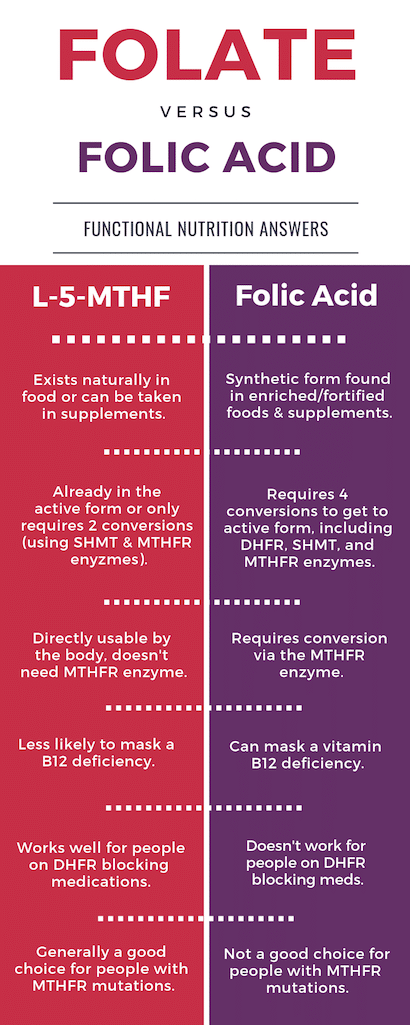
This enzyme helps convert folate into its active, usable form.
The Key Issue: Folic Acid Is Not Folate
This distinction is everything.
- Folate is the natural form of vitamin B9 found in foods like leafy greens, legumes, citrus, and liver.
- Folic acid is a synthetic compound created for food fortification and supplements.
The body must convert folic acid into active folate before it can be used.
This conversion depends heavily on the MTHFR enzyme.
The body must convert folic acid into active folate before it can be used.
Not everyone can do this efficiently.
MTHFR: When Enrichment Becomes a Burden
When the Enzyme Is Slower
Many people carry MTHFR gene variants (such as C677T or A1298C) that reduce this conversion efficiency.
This does not mean something is “wrong” with them.
It simply means their body:
- converts synthetic folic acid less efficiently
- may accumulate unmetabolized folic acid
- struggles when exposure is constant and excessive
And in the modern food system, exposure is constant.
People with MTHFR gene variants have a reduced ability to:
- convert folic acid into usable folate
- properly methylate nutrients
- detoxify excess synthetic compounds
When folic acid accumulates unmetabolized, it may:
- interfere with natural folate receptors
- contribute to fatigue, anxiety, headaches
- worsen inflammation
- disrupt neurological balance
- create paradoxical deficiency symptoms
People with MTHFR variants are not defective they’re overwhelmed.
They are often:
- more sensitive
- more responsive to real food
- more affected by synthetic inputs
- more resilient when nourished properly
Their bodies are simply asking for food in its natural language.
And here’s the quiet truth:
Many people have MTHFR variants and don’t know it.
It’s Not Just MTHFR
Even without genetic variants, enrichment such as folic acid can negatively affect:
- gut health
- mineral and nutrient balance (especially iron overload)
- nervous system sensitivity
- children with developing brains
- people with autoimmune or inflammatory conditions
The body thrives on synergy, not isolated chemistry. Adding isolated nutrients into a damaged food matrix doesn’t restore harmony—it forces chemistry onto biology.
Enrichment Masks the Real Problem
Enrichment allows us to ignore:
- depleted soil
- over-refined grains
- poor dietary diversity
- industrial farming practices
- loss of traditional preparation
Instead of fixing food, we patch symptoms.
Potential Effects of Excess Synthetic Folic Acid
When folic acid is not properly converted, it may:
- compete with natural folate receptors
- mask true folate deficiency
- disrupt neurotransmitter balance
- contribute to fatigue or brain fog
- increase anxiety or irritability
- worsen headaches or migraines
- interfere with immune signaling
This can happen even when blood tests appear “normal.”
The issue is function, not quantity.
The Natural Way Was Never Deficient
Traditional diets provided nutrients through:
- whole grains prepared properly
- fermentation and soaking
- fresh vegetables
- seasonal eating
- mineral-rich soils
Food worked with the body—not against it.
God’s design didn’t require enrichment.
It required stewardship.
Where Fortified Foods Become a Problem
In the U.S., folic acid is added to:
- white flour
- bread
- pasta
- rice
- cereal
- crackers
- snack foods
- meal replacements
- many supplements
Someone with an MTHFR variant may consume multiple fortified products daily without realizing it.
The body doesn’t experience this as nourishment — it experiences it as overload. And significant health issues follow.
A Healthier Way Forward
We don’t need more synthetic additions.
We need better food.
This is not about fear.
It’s about discernment.
Whole Food Folate Works Differently
Natural folate from food:
- comes with enzymes and cofactors
- is absorbed gradually
- supports methylation gently
- respects the body’s pace
Foods rich in natural folate include:
- leafy greens
- asparagus
- brussel sprouts
- lentils
- chickpeas
- beans
- peas
- beets
- citrus
- avocados
- nuts
- seeds
- liver
- eggs
These foods nourish without forcing.
Choose Foods That Don’t Need Fixing
- organic, unenriched flours
- naturally folate-rich foods
- whole grains prepared traditionally
- fermented foods
- diverse plant intake
Read Labels Carefully
- look for unbleached and unenriched products
- be mindful of fortified cereals and bread and avoid them
- choose unenriched flours and grains
- eliminate reliance on enriched / fortified packaged foods
- eat folate-rich whole foods regularly
- read ingredient labels carefully
- prioritize traditional food preparation
- respect individual tolerance and response
For many, less intervention brings more balance.
Nourish the Body, Don’t Override It
True nutrition supports the body’s intelligence.
It doesn’t try to outsmart it.
Food Is Not a Vitamin Delivery System
Food is:
- information
- relationship
- rhythm
- nourishment
When we reduce it to chemistry, we lose its wisdom.
Returning to Trust and Wisdom
The closer food stays to its natural state, the less the body has to compensate.
For those with MTHFR variants — and for many others — real food is not a trend.
It’s relief.
Many countries chose caution.
America chose convenience. And we paid the price in our poor health.
Now individuals are reclaiming discernment.
Not through fear—but through understanding.
The closer food stays to its natural state, the less intervention the body must endure.
And the body—when honored—knows exactly what to do.
Thank you for being here with me. I’m so grateful you have joined us along our journey of better health and wellness. For you are ALL worth far more than rubies.
Until next time, be well, my friends. Be gentle with yourself. Live with greater intention and love more abundantly. God bless you all.
BIG LOVE,
Char~